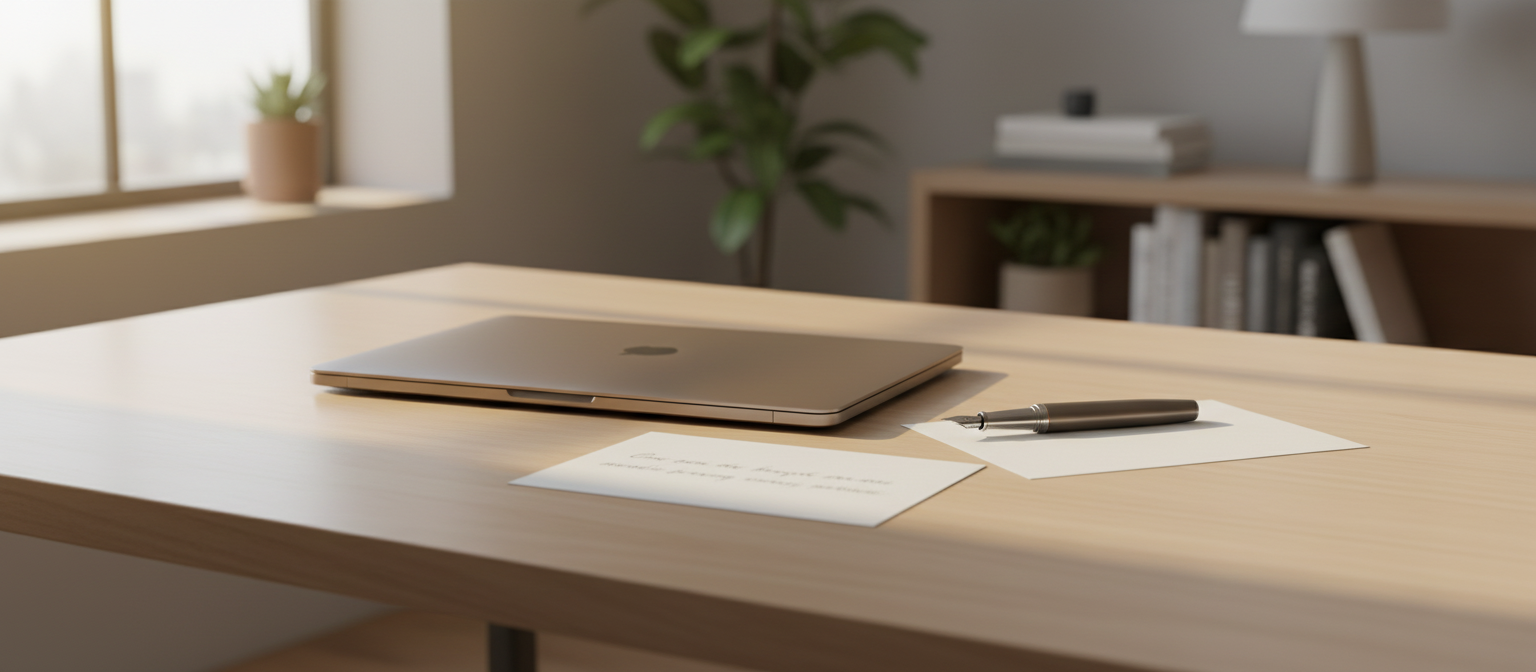
I send at least one handwritten note every week.
It's slow. It's inefficient. It can't be scaled. And it lands differently than anything digital ever will.
The person who receives it knows I sat down, picked up a pen, thought about them, and made marks on paper that traveled physically through space to reach their hands. You can't automate that. You can't outsource it. And that's precisely why it matters.
I'm telling you this because I also use AI tools - regularly. I draft content with them. I organize my thinking with them. I manage social media across multiple platforms with their help. I'm building several ventures simultaneously, and the throughput would be impossible without these tools.
So which is it? Am I a Luddite writing letters by candlelight, or a tech-forward leader leveraging every new capability?
Both. And I think that's the point.
Two Voices Worth Hearing
I've been reading two very different perspectives on AI lately, and they've been arguing with each other in my head.
The first comes from former Adobe colleague Scott Belsky, who writes about what he calls "Superhumanity" - the idea that as AI automates more of our work, humans must lean into what makes us distinctly human: our taste, our agency, our willingness to take risks that no algorithm would recommend. In this view, AI is like a jazz partner. You improvise together. It handles the technical execution; you bring the vision, the discernment, the audacity to try something that doesn't fit the pattern.
The second comes from a group of writers at New Polity who argue that the form of our technology shapes us more than we realize. That every "efficiency" comes with a hidden cost. That the screen can become a substitute for showing up - and that some of the most important things in life can't be optimized.
I find myself agreeing with both of them, which should be impossible.
The Screwdriver and the Drill
Here's where I've landed: The question isn't whether to use AI tools. The question is whether you know the difference between a screwdriver and a drill.
Sometimes the slower, more manual approach is right for the job - the handwritten note, the unhurried conversation, the unoptimized presence. Sometimes the amplified tool lets you do more of the work that matters. Wisdom is knowing which.
Early in your career, the drill wins almost every time. Speed matters. Volume matters. You're building capability, establishing credibility, proving you can produce. The rewards go to those who can do more, faster.
But something shifts in the second half.
The questions change. You start asking not just "how much can I produce?" but "what actually requires me?" Not just "how can I be more efficient?" but "where does efficiency miss the point entirely?"
The drill is still useful. But you start reaching for the screwdriver more often.
Tools, Not Termini
The real danger with any powerful tool isn't using it. It's letting it become the destination rather than a means to something else.
When the tool becomes the terminus - when the dashboard replaces the conversation, when the Slack message replaces the walk down the hall, when the AI-drafted email replaces the phone call that actually needed to happen - something essential is lost.
I use AI to help me prepare for coaching conversations. But the conversation happens with a real person in transition who needs someone to witness their struggle. I use AI to organize my content calendar. But the insight that matters most often comes from an unhurried coffee with someone who's living the same questions. I use AI to extend my reach. But the relationships that have shaped my career were built in rooms, not on platforms.
The virtual mind serves the incarnate one. Not the other way around.
The Leadership Shift
Here's what I've noticed in leaders navigating the second half well:
They're not anti-technology. They use every tool available. But they've developed a instinct for when to put the tools down.
They know that some of the most important leadership moments can't be optimized, scaled, or delegated. They require presence - your presence, your attention, your willingness to be in the room when it's uncomfortable.
They've stopped measuring their value by throughput alone. They've started measuring it by the moments that only they could have created.
They've made the pivot to the real.
The Discipline
I'm still figuring this out. I'm running multiple platforms and ventures, using every tool available. And I'm also writing one handwritten note a week, minimum, to someone who needs to know they matter.
Both are true. Both are necessary. Wisdom is knowing which moment calls for which.
The handwritten note isn't efficient. That's the point. It's a weekly discipline that keeps me calibrated - a reminder that the most important things I do as a leader will never show up in my productivity metrics.
The Question
If you're in the second half - or approaching it - here's what I'd ask:
Where in your leadership have you let the tool become the terminus?
Where are you optimizing for efficiency in places that actually require presence?
What would it look like to build one "screwdriver discipline" into your week - something slow, unscalable, and irreplaceably human?
The drill has its place. But sometimes what the moment needs is a pen, a walk down the hall, or your undivided attention.
Michael Halbrook helps leaders navigate the second half of life. He writes weekly at LeadAndKeep.com.
Also: The 5 Questions for the Second Half launches February 26. Sign up to get it free.
Comments
Sign in to leave a comment.